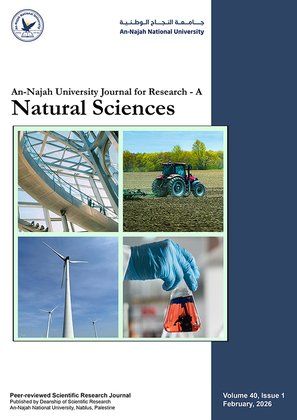


Aims and Scope
An-Najah University Journal for Research – A (Natural Sciences) is an interdisciplinary journal of fundamental and applied sciences research that covers theoretical, experimental, and practical studies in different fields, such as biology, chemistry, physics, mathematics, and engineering. The journal aims to highlight novel and original advances in the natural sciences and engineering fields.
Manuscripts submitted to the journal must be of high quality, well-performed, well-documented, and should make a significant contribution to the field. All manuscripts are evaluated by a team of reviewers and editors to ensure originality, quality, and accuracy of the content.
The scope of the journal is interdisciplinary and may cover topics in:
- Biotechnology, biochemistry, and biophysics
- Agricultural studies, soil, animal, and plant studies
- Nutrition, health, and sport studies that involve scientific investigations
- Chemistry, with branches in analytical, physical, organic, inorganic, and theoretical research
- Nanotechnology and its applications
- Material science and the chemical industry
- Environmental problems and challenges
- Fundamental and applied mathematics and physics
- Research in various engineering fields, including civil, architectural, chemical, industrial, and mechanical
- Renewable energy, covering research in the following areas: biomass conversion, photovoltaic technology conversion, solar thermal applications, and wind energy
- Solar energy research, development, application, measurement, or policy
- Computer science and information systems, including data science, smart applications, artificial intelligence, and the Internet of Things